Saturday, 23 January 2021

Scenery update

Just a quick update on how the scenery is progressing. After the spakfilla had all dried, I added strata lines and carved other erosion lines into it with a circular file. I also took sandpaper to it to prevent that smooth look.

The first coat of yellow has been far too yellow. In my haste to see nature bursting off the modules I've mixed up a darker batch of the yellow wash than I had used on Rozelle Street. This has caused me some problems which I've spent the last two weeks trying to work around.

The first golden layer:

I then applied some more orange/light brown highlights to give variation:


I then applied the grey/brown wash over the lot to get to where I should be:


After this step, the darker yellow really threw me. To my eyes, it stick out too much and isn't the subtle, muted colour I was after.


So I tried making it a little darker with a very dark grey/brown wash, which to my eyes looks good as weathered, exposed rock, but the sheltered cracks and crevices were still too yellow. 


Disgruntled, and contemplating how best to tear the entire landform off and bin it, I was complaining to my wife one night when she suggested that a terracotta/pinkish-orangish wash might save it. 

Bingo!

I mixed some up (pictured in the plastic container below) and swept it across the rock with a 2-inch foam brush. Instantly better.


I still need to finish adding some darker layers and the terracotta 'repair' wash, but it's getting there. 


I've also started chopping up some Lars Op't Hof scenic mats and placing them around the layout to see what grabs me. 


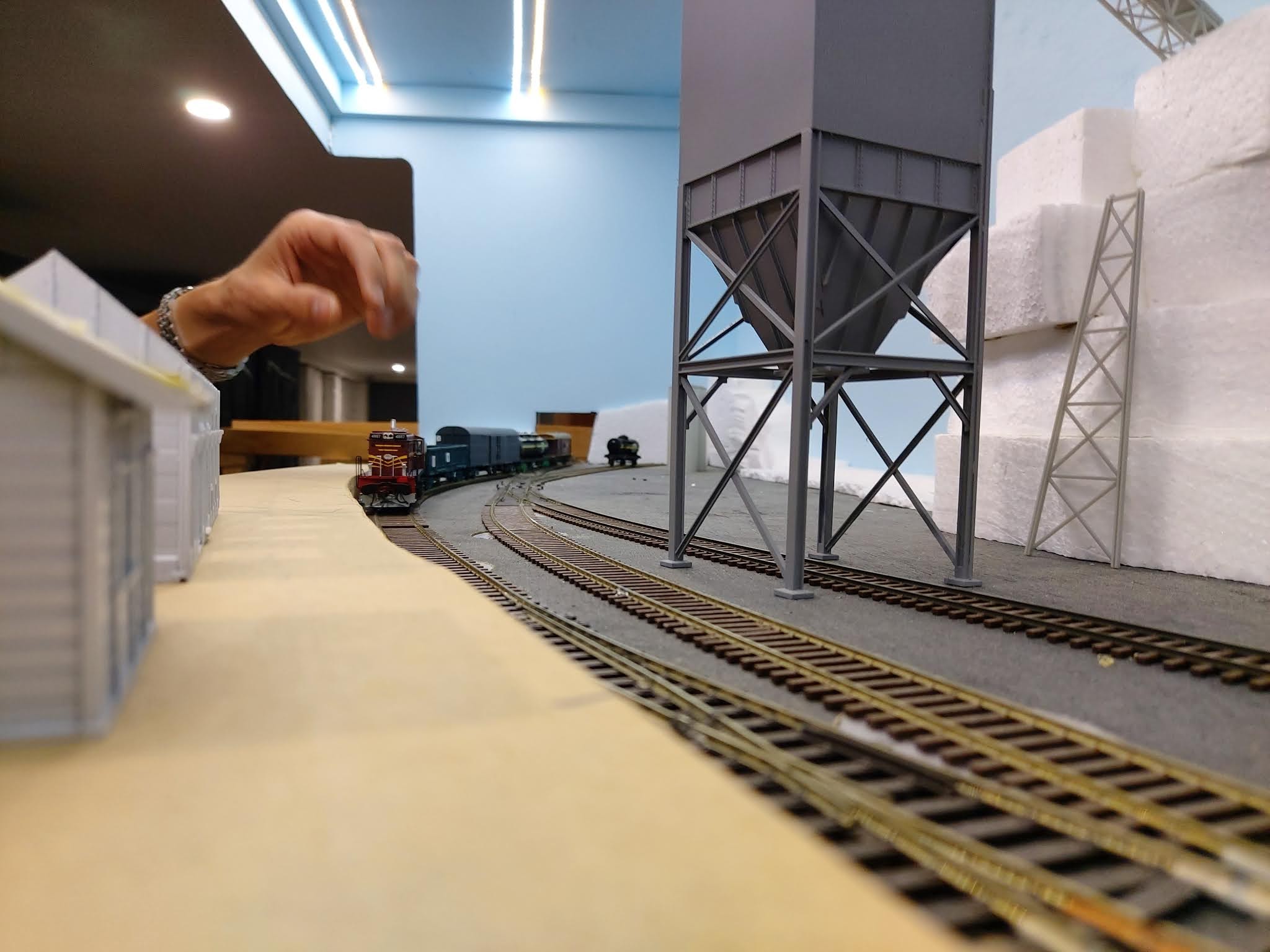
I'm aiming to get the station buildings finished on Monday and hopefully get an initial layer of dirt and ballast down as well. That should bring me to a point where I can some basic grass and foliage, and start running trains.

I've got a deadline to get the buildings and a basic level of scenery done by the end of February for the layout's first operating session. I'm aiming to have overhead and some initial signals installed by March. 

Will see how we go in February.

Cheers,
Ben


Sunday, 10 January 2021

Scenic progress

With the last few days of annual leave coinciding with my son starting at daycare, the perfect opportunity arose to embed myself in the train room for a few days. While I haven't had Rozelle Street levels of progress, the layout has made a big leap forward.

With the alignment and location of uncouplers finalised through the operations session, I sealed around the Rapido uncouplers with some coloured caulk to make them less conspicuous after scenery is applied.


I then shaped the final styrofoam landform and fixed it to the layout with liquid nails.


The layout was now ready for painting. I've had some issues with the past with different types of spray paints 'eating' some styrofoam, so I masked the foam before spraying the sleepers and rails. The sleepers were sprayed with Fiddly Bits Grey Primer. 


Before I masked and sprayed the rails I tested the desired colour on the siding that is most going to be covered in filth and render whatever I spray unrecognisable - the coal siding.


For the rails I use Krylon brown. The ultra-flat application of this paint doesn't overpower the code 70 rail. Happy with the above result, I set about masking the rails with painters tape, which took around 2.5 hours.


The result is worth it I think. I intend to paint a number of the sleepers with varying colours to break of the uniformity of the light grey.


I then applied Spakfilla Rapid to the foam to start to get the landform, exactly as described in my previous posts about scenery on Rozelle Street. I used about 1.5 of the larger tubs for this one - significantly more than on RS!


In the coming days I need to start sanding the dried spakfilla and drawing in the strata shapes of the rockform. I plan on painting and weathering the rock exactly as on RS, however with some colour variations more typical of the Blue Mountains. I've found on recent trips to photograph the rock colours that underneath the layer of aged black there's a lot more orange woven through the sandstone yellow. I'm really looking forward to having a go of replicating it.

While I've been working on the layout this week, I've also laid a half-metre section of code 70 track on a board and treated it to the same sleeper and rail painting before trying each of those steps on the layout. Here's a preview of where I'm heading with the yard dirt:

I've been following a Victorian-themed layout on one of the Facebook groups recently where the owner has used coloured tile grout as the ground cover, with outstanding results. In the Jan 2021 issue of Model Railroader, there's also an article about using this material as ground cover. The above picture is the result of 1 part black, 2.5 parts light grey and 2 parts 'truffle' (an earthy brown colour). I'm using the Davco brand from Bunnings. I'm fairly happy with it so far but I'm going to keep playing around with colour variation. Hopefully the next installment on this blog will have a lot more progress in that direction.

Finally, if you're an AMRM reader you'll notice a familiar wagon and layout in one of the smaller articles in the February issue ;) It was nice to be asked if I could put something together, and it motivated me to finish weathering the bogies and wheels for the photo of the completed model. With limited time, sometimes it can be all too easy to punt the weathering of bogies off into the future, but they do form a crucial part of the overall weathering on our wagons and rollingstock and influence how you view the finished product.

Until next time, happy modelling!

Cheers,
Ben


Saturday, 2 January 2021

Layout operations shakedown session


On the last day of 2020 my brother came over and helped me run an operations session on Mount Wilson to both test out whether after nearly 2 years of construction it still holds my interest from the original concept, and to ensure that all of the switches, servos, uncouplers and trackwork is up to scratch.

Buildings were placed on the layout to highlight drop off points, identify sidings, and get a feel for what it's all going to look like after a few more hours' work.

Mount Wilson. Sometime in 1979...

We started the theoretical roster in the early hours of the morning (ignore the midday lighting) with a local goods from Bell brought in by 4887 to swap the fuel tanker over and the fruit co-op siding. 

Being the first train this highlighted some very dirty track. My normal track cleaning routine is to go over the entire layout with a Peco track rubber and give it a good clean. I'd heard that isopropyl alcohol on some paper towel would provide a better clean, particularly for DCC, but remained unconvinced until our ops session. Below is the grot the first go with the isopropyl brought off, despite me cleaning the layout that morning. Call me Caesar and take me to the Iso temple - I'm converted.


After the quick clean, trains resumed. 

The 48 continued shunting and waited on the main for the morning commuter service (a partial MUB set) to arrive.


Normally this would be a 46 class, but I'm still waiting to get that converted to DCC. The local goods departed and the 85 changed ends to head back to Bell to connect with a service to the big smoke.


Next a local coal arrives. In my layout scenario, the mine has opened a larger loader a little further on down the branch beyond this terminus. Smaller trains still call here at Mt Wilson yard to use the old loader while operations settle. I have an operating rule on this siding that the mine company won't allow electrics under the loader. The 85 rearranges the van and proceeds to shunt wagons through the loader


A U set arrives with a mid-morning commuter service to the city. The 85 will follow it out, back to Bell.


All trains back in the fiddle yard after about 2.5 hours' operating time.


Overall, I'm quite impressed with how it all went. To be honest, the constant backwards steps and slow progress had me considering tearing the lot down and starting again, but I was really glad after we ran it all through. The spark from the original concept was still there and provided both a variety of trains and achievable operations.

Some lessons were identified:

-the local goods needs to use the coal siding to run around due to a lack of uncouplers. I'm ok with this for now.
-the imposition of 'mine company rules' for the siding (speed limit, ban on use of electric locos under the loader) add operational interest, so I'll retain these.
-despite making the coal siding now a through road, the 2-wagon-at-a-time shunting sequence works as planned and adds operational interest. The railways would avoid this as much as possible through things like trip trains or in the case of coal operations, adding another guards van to remove time-consuming shunting to the other end. I'll need to invent a reason for the 2-wagons practice.
-all wagons fit the station road
-we identified an option for larger coal trains to run through Mt Wilson to the new loader further down the line, to run around (or appear to have gone around a balloon loop) to allow both longer trains and further operational interest
-my brother suggested considering getting some R cars for a school train. R cars were used in the mountains on a school train until 1983, so a version of this would both fit in my era, and the station platform!

After the session, we tested out some ideas; which of the Lars Op't Hof scenery mats to put where, and confirming clearances of the longest wagons through the station platform. All looking good so far!


Before work goes back later this month I plan on making a start on scenery, and I've started mocking up what this will look like. The scene will be completely transformed again with trees, dirt, ballast and a backscene.


The station is still under construction, but this scene is shaping up nicely.


Here's to 2021 being a good year for modelling at least. Happy New Year to the regular readers of this blog and everyone else who stumbles across it.

Cheers,
Ben

Saturday, 24 October 2020

October Update

New additions

I failed to mention during the previous post that my wife and I welcomed our son into the world in late June. You'd think that this would take up more of my time than it has, but instead, having every waking second dominated by a person who is completely dependent on you for survival forces you to be efficient with the 'spare' time you have. As a result, I'm a little more motivated to spend the time I would otherwise spend scrolling through the internet to get down to the layout room and make some progress.

Before we get to the layout update, some other additions...


The Auscision Indian Pacific sets arrived recently. The detail in these cars is beautiful, and for something that has been likely thrown, dropped and rolled on it's way from China to me, only two brake cylinders had dislodged from a bogie when I took it out. They were easily re-added with a drop of glue. 


My two 85's have substituted for two 46's to give the IP it's inaugral run around the layout. 

A friend of mine gave me some great advice when it comes to running your trains with a newborn: keep your most reliable locos and rollingstock on the layout, so that when you get ten minutes to run trains you're not wasting it trying to fault-find something. Great advice. The 85's fill this role for me at the moment and are hauling just about everything. My U-boat arrived back from it's sound and lighting upgrade a few months ago as well, and while it runs fairly well and sounds great, it's less forgiving than 12-wheel pick up of the 85's.

The only downside with running the IP is that I've found my passenger stock seems to have a lot less tolerance for sub-optimal trackwork than my freight rollingstock. It's useful in that I can see what needs to be improved, but a few of the IP cars' walkway diaphragms and buffing plates seem to lock with each other if there was a vertical difference in height which pushed one carriage above the other by the height of a coupler width or so. (You can exhale that breath, not all of the track is that bad). This only happens in one spot coming off the traverser and onto the loop, but still, it's an annoying niggle to correct.

Otherwise, it's an outstanding set to watch going around.


My only gripe is that the cars don't come with a marshalling order included in or on the box. In case you're also trying to work out the marshalling order for a set running in NSW, this is the common marshalling I use. From the Sydney end:

HM
ARL
ARJ
ARL
ARJ
ARM
AFC
DF
CDF
BRJ
BRJ
ER
HGM
KLY
(Loco's)

This is based on NSWGR Country train marshalling recorded in 1978. The NSWR sitting cars were normally added between the BRJ and ER, and sometimes between the HGM and locos. If you're looking at photos and trying to work out if you're looking at an up or down IP in NSW, the HGM was always behind the locos in the westbound direction leaving Sydney.

Auscision also released a limited amount of FAMs in a four-pack, which I grabbed as well. Just can't keep away from blue L7's...


And yes, this has started an inevitable need to collect an Auscision RUB set now so that I can run the Gold Coast Motorail. Somewhere. Eventually... Luckily a re-run of the RUB's is a number of years away!

Rarely, there was an FAM on the Southern Aurora, but this is didn't happen that often in my era. 

Layout progress, and regression...

Since July, I found that two of my turnout servos had failed and need to be replaced. They were non-responsive and the fascia controller was super-hot to touch. Something bad happening there, so we'll start with the servo's themselves and see what happens.

I managed to get the accessory bus working again though, and I'm happy to report that all of the Rapido uncouplers are working perfectly. 

I added the last remaining connection to the fiddle yard and laid track on it. I had to dog-leg a little to get it in, but so far none of the rollingstock has an issue with it. 


I've then been adding sanity boards/guard rails to all of the non-scenicked modules on the loop. Some old Triang bridge sides have come in handy and break up the monotony of the timber. 


The inner guard rail is set lower so that I can still see the trains and helps with re-railing if need be.


I've also glued the scenery foam in place ready for covering with spakfilla/plaster.

The next steps are to replace the turnout servos and then have an operating session to give the whole thing a bit of a shakedown before I go spending money and precious time on the scenery side of things.

Hopefully another update before December. Until then, happy modelling!

Cheers,
Ben


Saturday, 25 July 2020

Mid-year update

It's been a while between posts, but I'm glad to say the reno's are done, the train room is now waterproofed and looks less like it's been banished to the basement.

 To recap from the previous post, here it is before:


And after:


The builder altered the pipework from a bathroom above the layout room during the reno's (the box on the top-right of the above photo), which has necessitated alteration of the final arrangement of the layout in this space. In the new configuration, I've swapped the Mt Wilson and fiddle modules, removed the creek module, and a future scenic module for now. This has also shortened the overall loop by about 2m, but it makes a more achievable railway in the medium term. That's the plan anyway.

I took advantage of one of the many recent sales at Australian Modeller over the last few months to purchase some SDS models' JCW 80-foot container wagons. As you know, I mainly model the main west in the late 1970s, and until recently I hadn't found any photographic evidence of these wagons venturing anywhere but the main south during that era. A fellow South Australian modeller put me onto a history of the TNT-Alltrans Adelaide-Sydney services produced for a Modelling the Railways of South Australia convention a few years ago. This, and seeing a few other photos of these wagons in the consists of some general freight trains on the main west in one of the pictorial groups I follow on Facebook provided all of the convincing I needed to add these wagons to my roster. I probably won't run them on Mt Wilson all that often, but they could make a guest appearance on Rozelle Street, and if I take a main west consist to run at a club or exhibition layout in future. One of those "I like them, I'll make that work" purchases.  


Also - I've finally completed wiring the fiddle yard for DCC. It's been a long time coming, but this just leaves the much simpler task of wiring up the remaining loop modules.


I also tested out the JCWs on my loops into the fiddle yard. The Indian Pacific cars are due to arrive from Auscision in the next few months and are around the same length, so this is a good indication that they'll go around my layout for the odd occasion when I want to give that consist a run - completely out of context for the branch line scenario!


A few more weeks and I'll have a train running in a loop. Still planning to complete the basic scenery by Christmas.

Cheerio for now,

Ben

Friday, 24 April 2020

Tracklaying complete

While my time off wasn't as productive as I'd hoped, I did manage to achieve the tracklaying milestone.


Mainly so that I can remember how I did this in future, I'll briefly outline how the entryway bridge was constructed. I've used 19mm x 89mm pine, which rests on a horizontal 19 x 42mm pine support on either end of the curved modules that it joins.


To keep the bridge piece from moving I've used off cuts of pine and aluminium angle and fixed these to the right-hand curved module, and the other end of the bridge so that the bridge can only be put in place in one direction. While this controls for and reduces any lateral and vertical movement, I now need to come up with a way of preventing the bridge from sliding out if the curved modules get knocked at all. I think I'll use dowel, but again, this is reliant on either outside being legal again or waiting on a Bunnings delivery.


To lay the track I've used Trackrite foam to reduce some of the noise of running directly on plywood with no insulation underneath. Most of this was laid on a curve, so I cut the trackrite in half to make it easier to lay around the curve without lifting or warping. Once cut, I placed it aside and applied Selley's caulk in a coffee colour (it's better than white if used in scenic areas), which is smoothed out to a light spread with an off cut of pine. The Trackrite is then laid on top, another layer of caulk is applied and smoothed, and then the track is laid with the aid of Tracksetta gauges to ensure the 30" minimum radius is maintained throughout. Weights are then applied on top and left for at least 4 hours but preferably overnight.


When joining the track on the curve I've offset the rail joiners to prevent the 'kink' you sometimes see when the track is joined flush on a curve (see below). I've used code 100 in all of the non-scenicked areas for ease of use and because it's quite durable and forgiving.


While that was drying and setting, I received one of the Auscision stimulus packages I bought to keep the hobby (read: Australian Modeller) alive during the Covid-19 lockdown. These VR FQX flat/container wagons mainly ran in NSW on the main south, but I've seen at least one on the north coast, and it's reasonable to assume they ventured on the main west over the Blue Mountains at some stage. I'll do a little more work on making appropriate tie-downs for the caravans, but these add some variety to train loads.


In an effort to complete wiring I started on the fiddle yard.


And have added the bus wire to the first of the curved modules...


Only to discover that these terminal strip connectors aren't as a great as I thought they would be for connecting the bus wire between the modules. I've bought some RCA connectors instead and am now waiting for them to arrive from Jaycar.


Unfortunately that's it for Mt Wilson for a while. We've just moved out while a number of renovations to the inside of our house happen, including waterproofing the railway room.


When we come back the room will have gyprocked walls, a new ceiling and some downlights. Should make it a much more comfortable place to be. In the meantime, the railway has visited my brother's house for a while. Again.

Man that guy is a patient saint.


While I'm temporarily banned from the worksite that has become our house, I've brought the coal loading bin, the station and signal box and some modelling tools to finish them off. Should be able to plonk them straight in by the time we get back inside.

Until then, happy modelling!

Cheers,
Ben